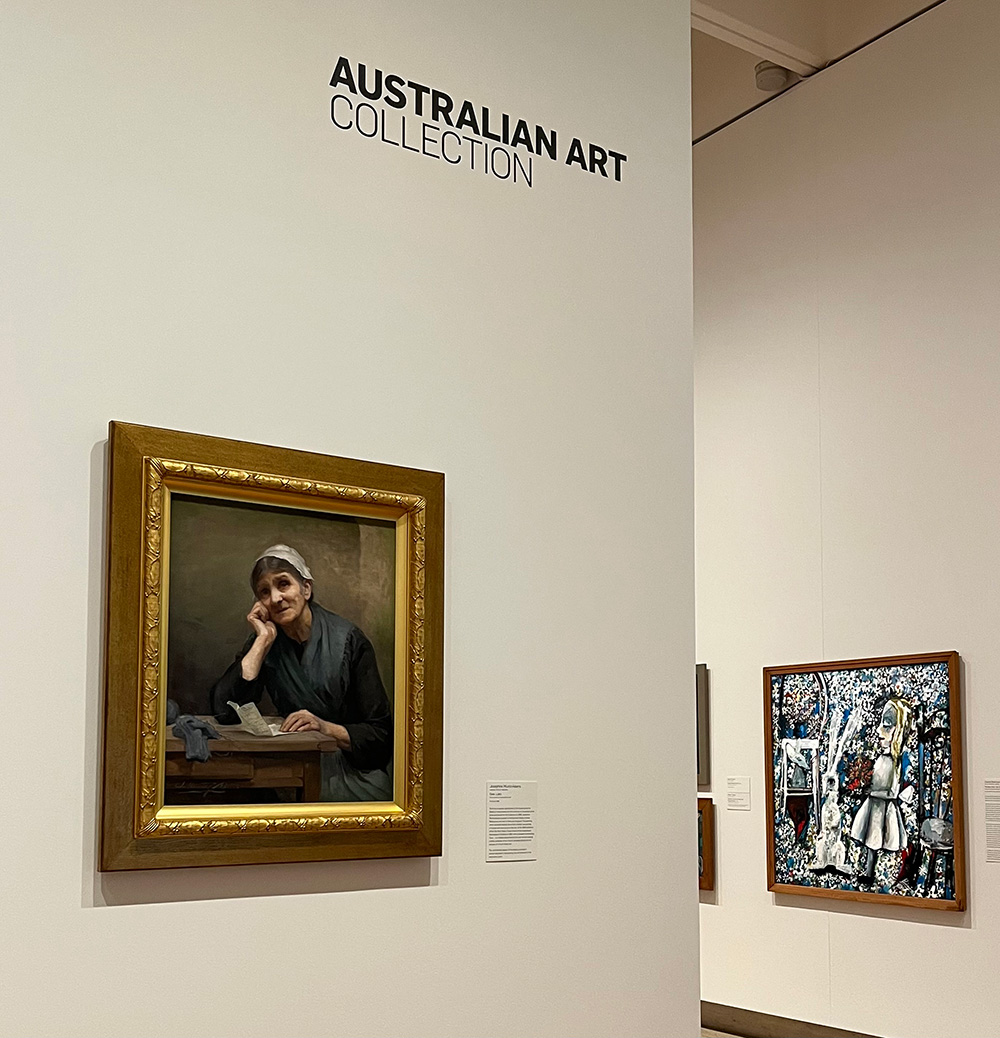
Josephine Muntz Adams’ Care has captivated audiences for over a century, but what inspired this masterpiece of quiet sorrow? The answer lies in loss, letters and family connections.
Care (c.1893) holds a special place in the history of Australian art. It has the distinction of two firsts: it was Josephine’s first painting to be purchased by an Australian gallery and the first by an Australian artist to be acquired for the Queensland Art Gallery’s collection in 1898.
It was painted during Josephine’s years as a student in Europe and was shown at the prestigious Paris Salon in 1893, where it had the honour of being hung ‘on the line’ – a position reserved for the most outstanding works, placed at eye level for maximum visibility.
Inspired reunions between mother and son
The emotional power of Care has long been evident, both in its subject matter and the way it connects with viewers. Shortly after Josephine’s death in 1949, the Brisbane Telegraph recalled a poignant anecdote shared by James Arthur Watts, curator of the Queensland National Art Gallery for over 30 years.
A few years after Care was shown at the Queensland International Exhibition in 1897, it was part of a regional tour of selected works from the Queensland Art Gallery. In the rural town of Chillagoe, Watts recalled a young man arriving on horseback, engaging with the exhibition in a ‘listless, leisurely way’. But when he gazed upon Care, his demeanour shifted. He approached Watts and shared the powerful impact the painting had on him:
‘That picture reminds me very much of my mother. I have left home and I haven’t written to her since. But I’m going back, because of that picture.’1
Afterwards, when the exhibition reached Charters Towers – more than 500 kilometres away – the young man returned, this time with his mother, whom he joyfully introduced to Mr Watts. This reunion reflects the painting’s universal themes of family and longing.

Memories of Long Ago: A precursor to Care
Despite the joyful reunion between mother and son, Care is steeped in sadness, if not tragedy – a theme Josephine had been ruminating on for several years. In 1889, the Australasian Sketcher with Pen and Pencil (a monthly magazine published by The Argus) featured an excerpt from a National Gallery School exhibition.
It included a sketch by Josephine called Memories of Long Ago. This sketch depicts a forlorn older woman, with a letter in hand and a young girl by her side. As described in the Australasian Sketcher, ‘a shadow of pain passes over [the woman’s] face, which is full of expression and character, and skilfully manipulated.’2 This description could easily be applied to Care, suggesting that Josephine’s ruminations on loss and grief were forming long before she painted her most famous work.
Memories of Long Ago was only a sketch, but it serves as a precursor to Care, exploring similar themes of mourning and separation. The motif of letters – now a long lost artform to most – appears as a symbol of the tyranny of distance and receiving news from afar.
Tragedy and the travelling scholarship
The ideas Josephine explored in Care were not unique to her, but shared by many of her contemporaries. In 1887, the National Gallery’s School of Art established the first National Gallery Travelling Scholarship, enabling emerging artists to travel to Europe for further study.
The first recipient, John Longstaff, won the scholarship with his painting Breaking the News. The painting portrays a mother learning of her husband’s death in a mining accident, and is filled with emotional depth and powerful use of light and shadow.
A few years later in 1890, Abe Altson (also featured in the exhibition sketches in the Australasian Sketcher above, albeit with his name misspelled) won the second scholarship with Flood Sufferings. It depicts a mother and child being rescued from a flooded house. Like Longstaff’s painting, it emphasises the pain of loss through careful composition and dramatic lighting.
As researcher and critic Kate Robertson has noted, Breaking the News influenced many future scholarship entrants. ‘The similarity between works was of course influenced by studying at the same school and being inspired by the same trends in art. However, it also indicates that artists looked to Breaking the News as a valuable prototype for their scholarship submissions, searching for what the judges would look for in a winning work.’3
Although Josephine never received the travelling scholarship, and was already studying in Europe by the time she painted Care, she was likely influenced by the same artistic trends. Her work shares similarities with those of Longstaff and Altson, as they were all students at the National Gallery School.
A family tragedy: the inspiration behind Care?
‘I could lie down like a tired child
And weep away the life of care,
Which I have borne and yet must bear.’Percy Bysshe Shelley
Percy Bysshe Shelley’s poem Stanzas Written in Dejection near Naples has been cited as the inspiration for Care4, but the personal context surrounding Josephine’s life at the time may have played a much larger role. The lines from Shelley’s poem mirror the sorrowful expression of the woman in Care. But who exactly is the woman depicted? What news does the letter contain? And what grief does she have to bear?
In 1897, a reviewer of the Queensland International Exhibition described Care as a ‘lifelike presentment of an old woman reading a letter, evidently of evil import, probably, telling the evil courses of a much-loved son’.5 The didactic that accompanies Care at the Queensland Art Gallery suggests that the woman could be Josephine’s mother, Jane Muntz (née Jamison), which is plausible given that Josephine’ often relied on family and friends as sitters for her works.
A deeper look at the Muntz family history offers more clues. In 1893 – the year Josephine painted Care – tragedy struck the family when her sister Florence Annie Gibb (née Muntz) passed away shortly after giving birth to her first child. Florence’s death likely weighed heavily on Josephine, who was studying in Europe at the time and would have only learnt of her sister’s passing through letters arriving in the post months later. Perhaps Josephine imagined this letter exchange between herself and her mother, interpreting the grief and sorrow through the figure in Care.
An enduring legacy
Whether or not Florence’s death directly inspired the painting, Care stands as Josephine Muntz Adams’ magnum opus. More than 125 years after it was purchased by the Queensland Art Gallery, the painting continues to resonate with viewers. As the gallery notes, ‘the sentimental appeal of the elderly, work-worn woman depicted in the painting has not lessened in the intervening years.’
Care remains a powerful statement of the human experience, its emotional appeal as relevant today as it was when it was first painted.


