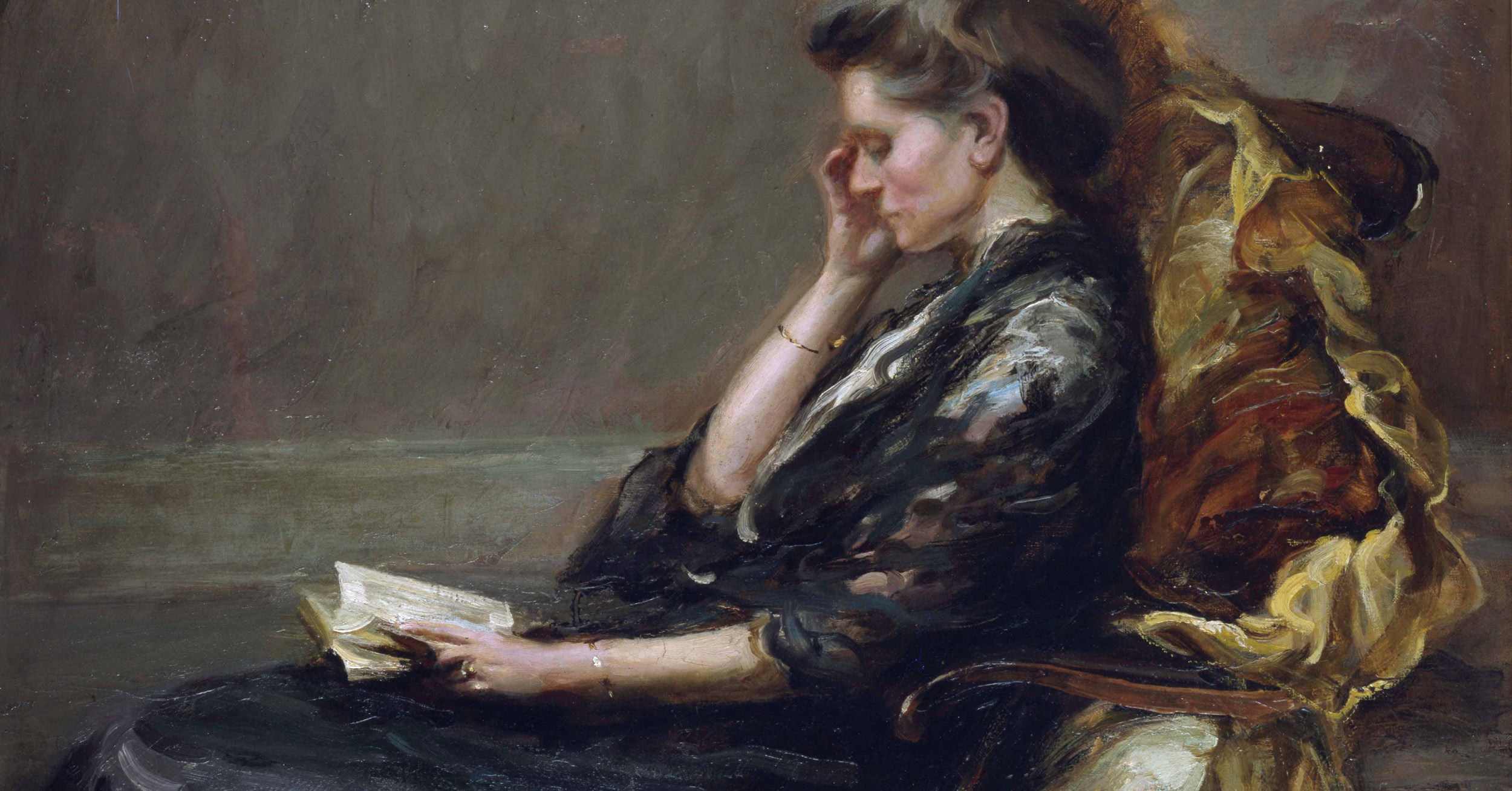
In the late 19th century, calling a woman’s work ‘masculine’ was the highest praise the art world could offer. It tells you everything about the world in which Josephine Muntz Adams painted.
In the mid-1890s, a young Australian woman arrived at the Herkomer School of Art in Bushey, England. She was talented enough to be singled out by Sir Hubert von Herkomer, one of Britain’s most celebrated painters. And the best he could offer her, by way of a compliment, was this: her work was ‘more like that of a man than of a woman’.1
That was the highest praise available. Not that she painted well. Not that she painted brilliantly. That she painted like a man.
Because excellence, apparently, had a gender.
A portrait that proved his point
Josephine later recalled that she ‘gained more real knowledge at Bushey than anywhere else’.2
Whatever Herkomer’s blind spots, his school gave her something real. She returned to Melbourne and built a career as one of the leading portraitists of her time, commanding up to £150 per commission – serious money in the 1890s.
One of her first major works on returning home was a portrait of Robert Lewis John Ellery – astronomer, surveyor and a significant scientific figure in colonial Victoria. Ellery had served as Victorian Government Astronomer for 42 years and as President of the Royal Society of Victoria for nearly two decades.
To be chosen to paint him was, in itself, a statement about where Josephine stood among her contemporaries. She began the portrait immediately on her return from Europe in 1896, though ill health delayed its completion until 1897.
The result drew admiring reviews. The Melbourne journal Table Talk praised the ‘kindly, contemplative eyes’ as the painting’s finest achievement, and noted the subtle technical accomplishment of a shadow cast by Ellery’s spectacles – ‘felt rather than seen’,3 the reviewer wrote, in a phrase that captures exactly what skilled portraiture can do.
And then, almost inevitably, the review circled back to Herkomer’s verdict: her work was ‘more like that of a man than of a woman’.4
Even her victories were measured against male standards. Every time she succeeded, the framing reminded the reader – and perhaps Josephine herself – that this was surprising. Exceptional. Not quite what a woman should be capable of.
Beyond the expected subjects
Women artists of the era were funnelled toward ‘feminine’ subjects: domestic interiors, women reading, women sewing, women gazing softly into mirrors. Passive. Decorative. Safe.
Josephine painted many of these subjects. She was a woman of her time, working within a world that had clear ideas about what she should produce. But she didn’t stop there.
While painters like Arthur Streeton, Frederick McCubbin and Tom Roberts were defining the image of colonial Australia – and routinely writing women out of it, or reducing them to background figures – Josephine was doing something different.
She travelled widely, and on one trip visited her brother Edwin, a civil engineer working in Coolgardie, and his family.
From that visit came Afghan Trader: a scene based on her sister-in-law Christine and two nieces bartering with a travelling hawker in the middle of the desert. There are no genteel interiors here, no women arranged decoratively for the viewer’s comfort.
These are women facing the grit and realities of frontier life – active, present, central to the scene. Josephine saw in the image what so many of her male contemporaries had missed entirely: ‘an original, yet inherently Australian, slice of life’.5

Why she matters – and why we nearly lost her
Josephine Muntz Adams earned serious commissions from Melbourne’s most prominent figures, and made work that challenged the boundaries of what a woman painter was supposed to produce.
And yet her name has faded. Many people who love Australian art have never heard of her.
This wasn’t a matter of quality. It was a matter of how the system worked – systematically undervaluing, underpromoting and ultimately forgetting the work of women artists. The language that followed Josephine throughout her career is a small window into exactly how that happened. Praise structured around exception and surprise. She’s good, for a woman. She paints, almost, like one of us. The framing kept even the most talented women at arm’s length from full belonging in their own field.
But the work survived. A portrait whose spectacle shadow is ‘felt rather than seen.’ A goldfields scene that put women at the centre of Australian life at a time when the celebrated painters of the era had pushed them to the edges. A body of work that refuses, even now, to stay forgotten.
She painted like a woman. One who was very, very good at it.


