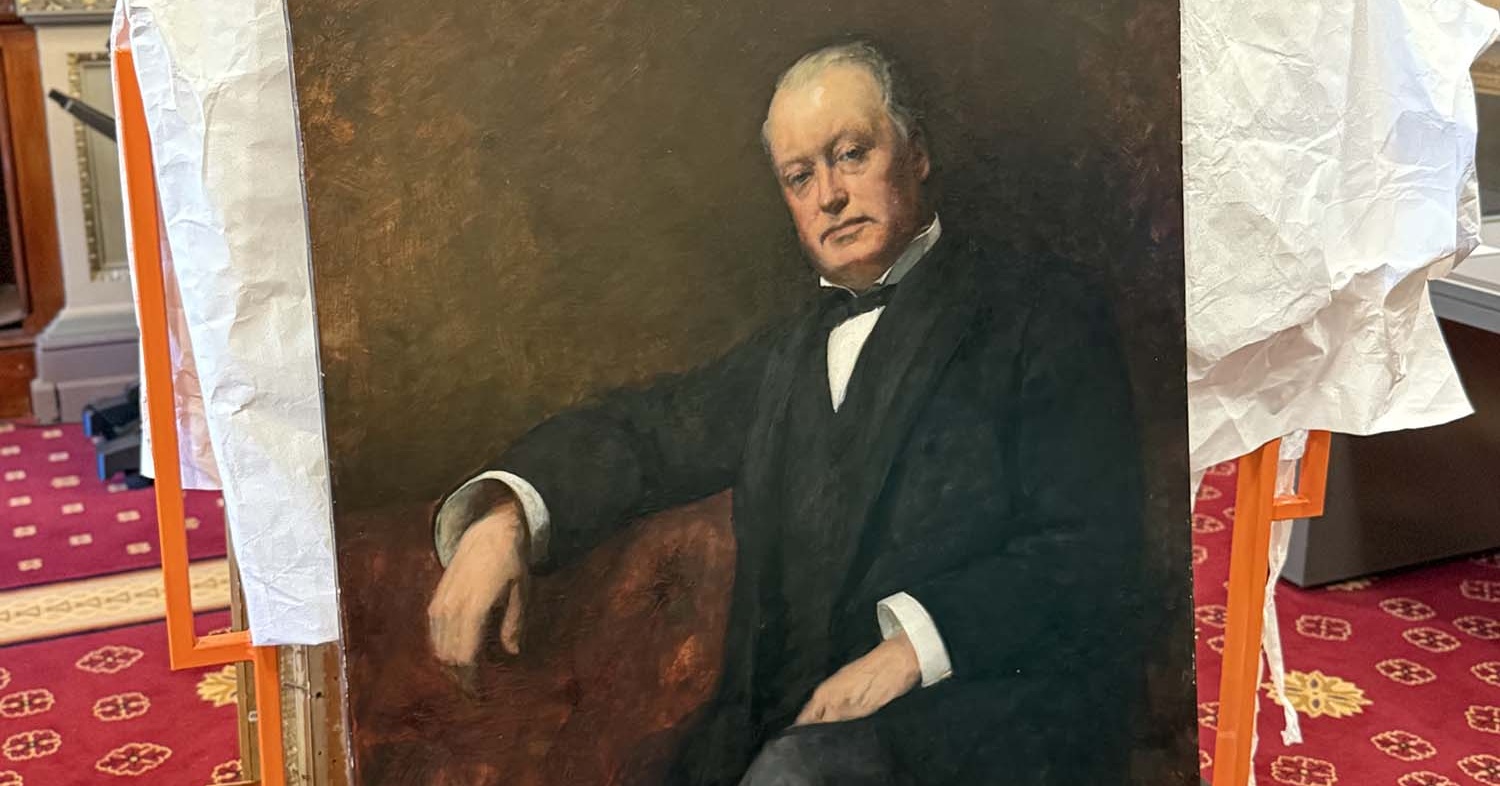
In 1895, former Victorian Premier Duncan Gillies had been pushed out of office and into a London posting that felt like banishment. In Josephine Muntz Adams’ studio, though, he found a sympathetic ear and an artist at the height of her craft. Now, more than a century later, a conservation treatment has revealed the portrait in a new light.
When a reviewer for Melbourne Punch stood in front of a freshly exhibited portrait of Duncan Gillies they felt something uncanny. The figure on the canvas – stout, affable, unmistakably alive – seemed on the verge of movement. “The spectator gets something of an eerie feeling,” the reviewer wrote, “and wonders whether the figure will walk out of the canvas and talk.”1
Almost 130 years later, the portrait has stepped out of its frame again – this time under a conservator’s brush, as decades of surface dirt and bloom are carefully lifted away.
The portrait was painted in 1895 by Josephine Muntz Adams, during her formative years studying in Paris and London. By then Gillies, the 14th Premier of Victoria (1886–1890), had been swept from office by a vote of no confidence and reluctantly taken up a new post as Agent-General for Victoria in London.
The Gillies portrait is one of the most significant portraits of Josephine’s career: a life-size, three-quarter-length study of a man who helped shape the colony of Victoria, painted by a woman at the height of her artistry.


A Premier in exile, a painter on the rise
A woman painting such a portrait was, for the 1890s, a rare thing. Parliament House Victoria holds no other commissions by female artists from the era. Shelley Jamieson, Coordinator of Heritage Services, notes that “our collection is not extensive” from this period, yet the rarity of the achievement is clear. Throughout the 1890s, Australian portrait painting remained a field dominated by men, even as women like Josephine were quietly dismantling that assumption.
Josephine’s path into such circles owed something to her upbringing. As Parliament House Victoria observes, “her father, Thomas Bingham Muntz, initially worked as a land surveyor, placing him in good social standing. His election to the role of Mayor of Prahran (in 1885–86) situated him in government circles.” That standing no doubt helped open doors for an ambitious daughter who intended to make a career of her art.
That comfort in elevated circles served her well when it came to Gillies himself. Josephine and Gillies established an easy rapport over multiple sittings. “Instead of having to entertain the Statesman, the Statesman entertained the artist with a flow of anecdotes that never stopped,” New Idea reported2. Table Talk noted the same warmth: he was “prompt at keeping his appointments, and considered it more his duty to entertain the artist, than for the artist to entertain him.”3
This was a man who had navigated some of Victoria’s most turbulent political decades: the gold-rush boom, a coalition government alongside the future Prime Minister Alfred Deakin, and the devastating depression that followed.
By the time Gillies sat for Josephine, he had reluctantly accepted the Agent-General post in London – a role widely seen as a form of political exile. Yet in Josephine’s studio he was relaxed, generous and full of stories.
Table Talk noted that Josephine had caught him “in one of his best moods – a sort of reflective-genial.” The painting shows it. “The cherubic flesh tints, characteristic of the sitter, are in no way subdued, and the expression is equally true.”4
“Working in this kind of free, unconstricted way is a real hallmark of Muntz-Adams' style, and perhaps also reflects that she was at ease with her sitter.”
Dr Catherine Nunn, Conservator


What the conservation treatment revealed
When conservator Dr Catherine Nunn recently undertook the treatment on the Gillies portrait she found much to admire – and a few surprises.
“The painting is executed in a very bravura manner,” Catherine says, “with confidently and loosely applied brush strokes in the face, and rich red glazes in the chair that add depth. Working in this kind of free, unconstricted way is a real hallmark of Muntz-Adams’ style. The rich red glazes help to amplify the dignity and status of Gillies as a political figure, while the freely applied brush strokes in his face convey a sense of his geniality.”
The treatment itself – surface cleaning, compensation of losses, stabilising the frame – revealed something unexpected: three signatures.
- The confident black “J Muntz” in the lower left corner
- A second, smaller signature in pink: “J M Muntz-Adams”
- Beneath the black signature, an earlier “J Muntz” in pale white-yellow paint (since covered over with the red background), surfacing as the aged oil paint has become more transparent over the years.
The two visible signatures are easily explained. Josephine painted the portrait in London in 1895, before her marriage to Samuel Howard Adams in August 1898. She originally signed it with her maiden name, and – as she did with many of her earlier paintings – returned later to add her married one. Why the earliest signature was painted over, though, we’ll never know.
Catherine also discovered pencilled numbers on the reverse of the stretcher – the wooden frame that holds the canvas taut – matching each wooden panel to its partner, alongside the word “Gillies” on each piece. The stretcher was likely disassembled for shipping back to Australia, with these annotations added to guide its reconstruction on arrival.
A portrait’s journey across the globe
After it was finished in 1895, the portrait was shipped to Melbourne. It was exhibited in 1896 alongside Josephine’s portraits of Charles Young (a fellow politician and the first Minister for Lands in the Victorian Government) and his wife, Annie Lyle Young*.
The Gillies portrait went on to win a gold medal at London’s Greater Britain Exhibition in 1898.
In 1905, it was purchased by the Gillies Memorial Committee, consisting of then Prime Minister Alfred Deakin and Premier Thomas Bent. The committee had collected subscriptions for a headstone and purchased Josephine’s portrait of Gillies with the remainder. On 26 June 1906, Premier Thomas Bent unveiled the portrait in a crowded parliamentary library.
Now, thanks to Parliament House Victoria and Catherine Nunn’s conservation treatment, the portrait is planned to go on display in 2027. Future viewers will be able to stand before it and feel, as the Melbourne Punch reviewer once did, as though Gillies himself might step forward and start talking.
Josephine Muntz Adams’ portrait of Duncan Gillies is part of the permanent collection at Parliament House Victoria. Conservation treatment was carried out by Dr Catherine Nunn. Thank you to Monica Syrette for the invitation to view the portrait during treatment and the additional research informing this article.
* Sadly, we don’t have images for the Charles Young or Annie Young portraits, but hopefully they will surface one day and we can add them to this online collection.


