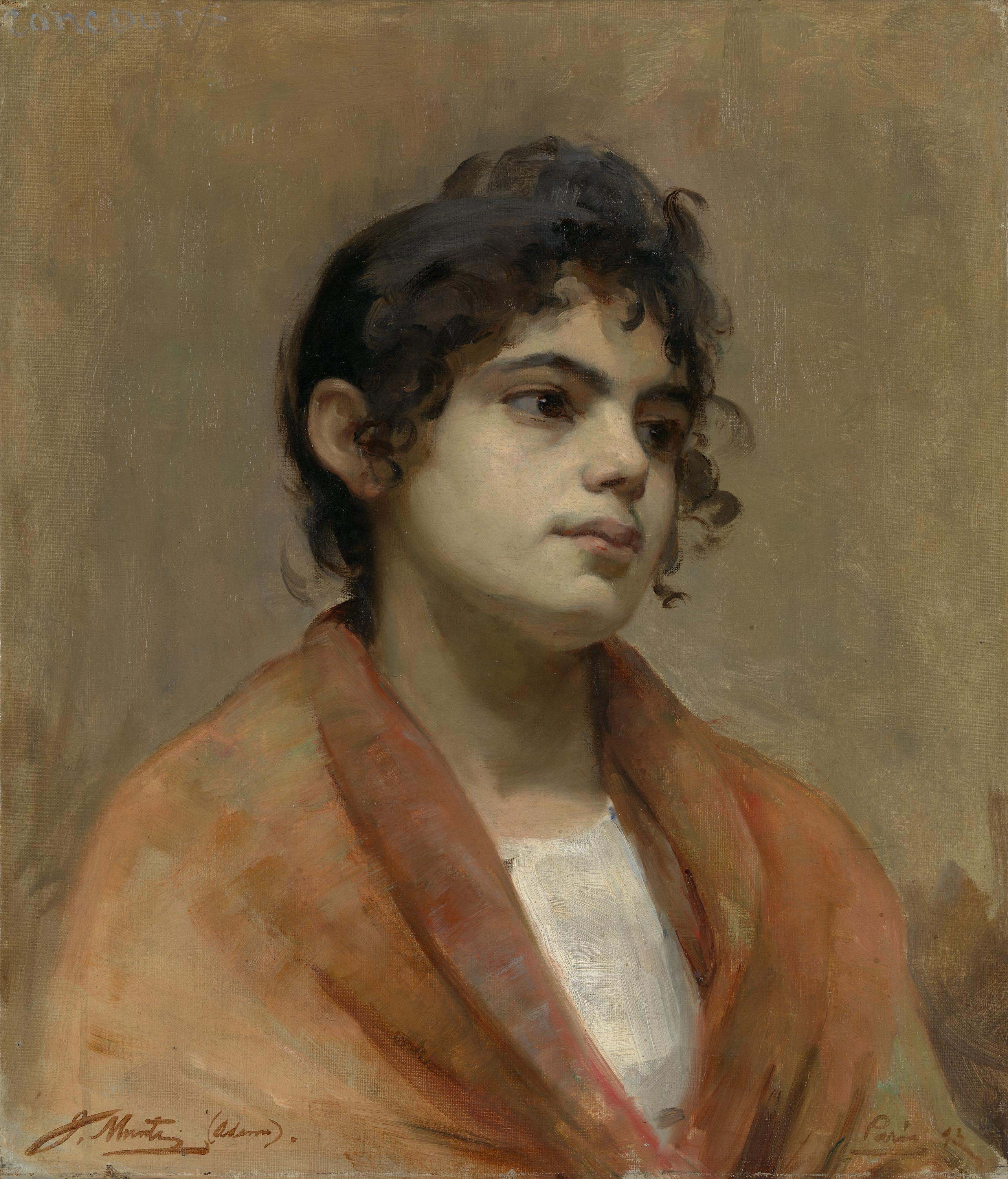
Today, Josephine Muntz Adams is represented in various galleries across Australia. But this wasn’t always the case. Her correspondence with the National Gallery of Victoria (NGV) reveals a stark shift in how her work was perceived – from a humble artist seeking due recognition in 1936, to a celebrated painter who work was actively pursued by the gallery in 1943.
Josephine’s most well-known work, Care, was the first painting by an Australian artist acquired by the Queensland Art Gallery, Gallery of Modern Art in 1898. Despite this groundbreaking achievement, decades passed before she gained broader recognition. Josephine’s works were largely confined to private collections, with the Queensland Art Gallery being the only institution to hold her paintings.1
This glaring omission from the gallery walls of Australia was rightly called out by the Brisbane Courier in 1930. ‘Although one of the most accomplished portrait painters that Victoria has produced, for some inexplicable reason she is not represented in the Melbourne Gallery.’2
A desirable addition to a national or civic collection
In 1936, the Ideal Home Exhibition at the Melbourne Exhibition Buildings showcased a range of Australian art. Although a few of the artworks ‘evidently slipped past the selecting body’, Josephine’s Portrait of a Young Girl caught the attention of The Age art critic:
‘The best work is naturally to be found among the paintings in oils, and in this section the work which claims most attention is a portrait of a young girl, by Mrs Muntz Adams. This study is distinguished by both able technique and a fine appreciation of lighting and values, and has, in addition, a temperamental quality which one does not always find in the work of the approved professional portrait painter. A smaller self portrait by the same artist is also worthy of special consideration as a desirable addition to a national or civic collection.’
‘The best work is naturally to be found among the paintings in oils, and in this section the work which claims most attention is a portrait of a young girl, by Mrs Muntz Adams ... a smaller self portrait by the same artist is also worthy of special consideration as a desirable addition to a national or civic collection.’
The Age, 22 February 1936, p.20.
Emboldened by the review, Josephine took matters into her own hands and wrote to the NGV’s Acting Director, William McInnes. Her letter reveals a mix of humility and quiet determination:
‘In the Age notices of the ‘Ideal home exhibitions’ on the 22 instant, there is reference to two pictures of mine as ‘worthy of consideration as desirable additions to a national or civic collection’. This has encouraged me to write to you to ask how the subject could be brought before those concerned in the purchase of pictures for public collections.
I have been out of the art world for so long, cut off by bad health and also entirely lacking in business acumen, which two things may explain my ignorance! I should exceedingly like to have these pictures, one or all, placed somewhere, other than the private homes of my friends.
Brisbane is the only gallery that possesses anything of mine – there are 3 there. The picture ‘Care’ is still widely appreciated there.’
Josephine’s letter to NGV’s Acting Director, William McInnes, asking him to consider her work for the gallery’s permanent collection.
Not quite up to gallery standard?
Josephine’s request was poignant. At the age of 74, she was past the height of her career and hindered by deteriorating eyesight. Yet she recognised the importance of having her work preserved in public collections. She offered two paintings, Study of a Young Girl (50 guineas) and Self-Portrait (40 guineas), even noting she would accept less than the stated prices.
The gallery’s response was polite, but dismissive.
While acknowledging the charm and quality of her work, McInnes deemed it ‘not quite important enough to recommend for purchase. Her work is above average quality, yet not quite up to gallery standard.’
However, he identified Head of a Young Italian Girl from the same exhibition as a ‘good example of portrait painting’ and recommended its purchase. The NGV acquired it for 60 guineas (approximately $6,000 in today’s currency).
‘Mrs Muntz-Adams belongs to the most important period of Australian painting to date – that of Roberts, Streeton, Phillips Fox, McCubbin and Longstaff.’
Sir Ernest Daryl Lindsay, Director, National Gallery of Victoria (1943)
From rejection to renown
By 1943, seven years later, the tone of correspondence with the NGV had shifted dramatically. Following Josephine’s celebrated exhibition at the Athenaeum Gallery, NGV Director Sir Ernest Daryl Lindsay wrote to the Chief Librarian and Secretary, advocating for the acquisition of Josephine’s work:
‘Mrs Muntz-Adams belongs to the most important period of Australian painting to date – that of Roberts, Streeton, Phillips Fox, McCubbin and Longstaff – and deserves to be represented in our collection by more than one work. The two pictures submitted are first-class examples of this artist’s work: both are beautiful colour harmonies, sound in craftsmanship, and are the work of a most accomplished artist.’
The NGV approved the purchase of Girl Reading for 50 guineas ($5,000 today). In addition, the NGV purchased two smaller works, Sarah Afternoon (12 guineas, $1,200) and Side Canal Bridge (10 guineas, $1,000), citing their educational value for students 3
The change in tone from 1936 to 1943 reflects more than just a growing appreciation for Josephine’s work; it underscores the evolving recognition of women artists in Australian art history. From humbly advocating for her own work, to being acknowledged as a peer of Australia’s most celebrated painters, Josephine’s story is one of perseverance and triumph.
The correspondence pertaining to the NGV’s acquisition of Josephine’s work was sourced from the Public Records Office Victoria.


